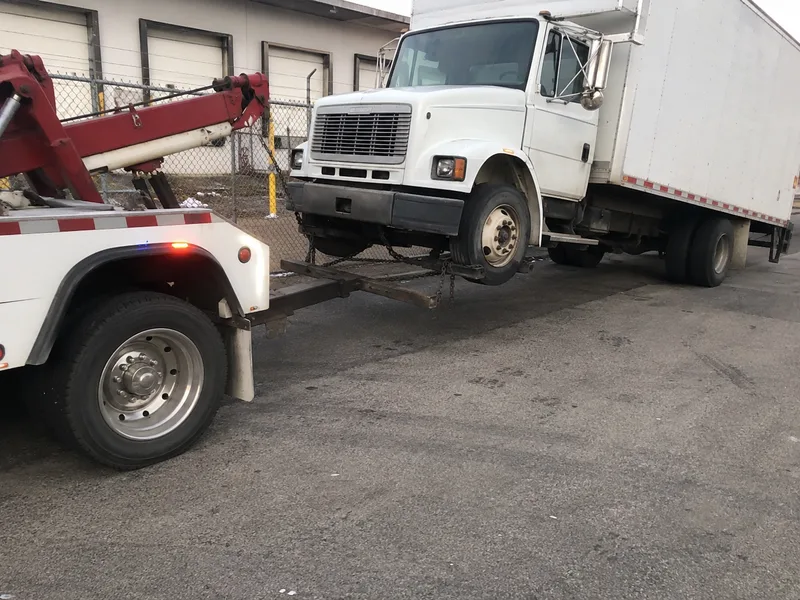
A loaded box truck on the shoulder isn't just a breakdown, it's a meter running. Missed delivery windows, a driver on the clock, freight that somebody downstream is calling about every twenty minutes. Heavy duty towing in Atlanta is a different business than car towing, heavier iron, more rigging, more ways to get it wrong, and we built our medium and heavy capability around the customers who feel every stranded hour in dollars.
What We Tow With the Big Truck
Meet Big Pete, our Peterbilt 337 wrecker with an under-reach capable of handling the trucks a standard wrecker can't touch. On his dance card in a typical month:
- Box trucks and straight trucks, the U-Hauls, Isuzus and Freightliner M2s that keep Atlanta commerce moving
- Buses, shuttle vans and motorcoaches, church buses are their own Sunday tradition
- RVs and motorhomes, Class A through C, plus travel trailers and fifth wheels
- Bucket trucks, stake beds, flatbed work trucks and other vocational iron
- Semi tractors bobtailing or with empty trailers
- Skid steers, forklifts, small excavators and other equipment moved on our deck trailer
Straight talk on the top end: a fully loaded 80,000-pound tractor-trailer recovery, overturned on a ramp, needing a rotator crane, is specialist work with equipment only a couple of Atlanta operators own. If your situation is that situation, we'll say so on the first call and hand you the number of the outfit we'd call for our own truck, instead of dragging a job we shouldn't. That honesty costs us nothing and it's why fleet managers keep our number.
Trucks Break Differently
Cars quit. Trucks fail in more creative ways. Air systems that won't build pressure, so the spring brakes lock the truck where it sits, we cage brakes and get it moving legally and safely. Clutches and transmissions that give out mid-hill on Cleveland Avenue. Cooling systems that surrender in July stop-and-go on the Perimeter with the AC screaming. Loads that shift, which is a recovery-and-restack problem before it's a towing problem. DEF systems that put a truck in limp mode at the worst address possible. Our drivers are truck people, Otis ran line-haul for a decade before he ever touched a wrecker, and the difference shows in how a disabled truck gets diagnosed, rigged and moved without adding a repair bill.
Light, Medium, Heavy: What the Classes Actually Mean
Towing companies throw these words around and rarely define them, so here's the working translation. Light duty covers everything through about 10,000 pounds GVWR, cars, SUVs, pickups, vans, the world of our flatbeds. Medium duty runs roughly 10,000 to 26,000 pounds, box trucks, shuttle buses, larger RVs, ambulance-sized vehicles, and requires a genuinely different truck: heavier chassis, under-reach equipment, air brake connections to run the towed vehicle's brake lights and, critically, supply air. Heavy duty is 26,000 pounds and up, semi tractors, motorcoaches, loaded straight trucks, where the wrecker itself weighs more than most things it passes. The reason the distinction matters to you: a light-duty truck attempting a medium-duty tow isn't a bargain, it's a physics violation with your vehicle attached, and it's the number one thing to screen for when a too-cheap quote appears. Ask what truck is coming. The answer should include a model, not a shrug.
On cost: medium and heavy work prices by tonnage, distance, and rigging complexity, and the honest range for a straightforward metro-area medium-duty tow runs a few hundred dollars, escalating with weight and mess. What we promise is the same structure as everything else here, a firm all-in number before hookup, itemized if your office needs it, no scene-side renegotiation. For context on the light end of our pricing, the rates page has the full table.
Where Trucks Die in Atlanta
Ask Otis for the map and he'll draw it from memory. The I-285 westside freight corridor and Fulton Industrial Boulevard, warehouse country, where box trucks fail at dock doors and diesel problems announce themselves at 5 a.m. The Cleveland Avenue and Moreland Avenue grades, which find every weak clutch in the delivery fleet. The airport perimeter, where shuttle buses and cargo vans run hard hours. Spaghetti Junction, where a stalled truck at rush hour makes the traffic report before the tow truck arrives, GDOT's incident units keep lanes moving there and we routinely work scenes alongside them. And every July, the Perimeter's stop-and-go, which boils the cooling system of any truck that was marginal in April. If your fleet runs these roads, your trucks will eventually meet us. Better it's on purpose, with an account, than at 2 a.m. through a Google search.
A Note for RV Owners Specifically
RVs deserve a special mention because they combine truck-scale weight with car-owner expectations and a house's worth of plumbing. Before the truck arrives: slides in if they'll retract, antennas down, awnings secured, propane off at the tank. Tell dispatch the length and whether it's a motorhome or a towable, a fifth wheel needs different equipment than a Class C, and tell us honestly about ground clearance, RV steps and dump valves hang lower than owners remember. Breakdowns cluster around I-75 north of the metro in camping season, and we've learned to ask one extra question: is anyone living aboard right now? Pets, full fridges and travel plans change how fast we route the call, and we'd rather know from the first minute.
What Happens on a Commercial Scene
Truck tows involve paperwork and judgment calls that car tows never see, so here's the sequence your driver or fleet office can expect. First, assessment: what failed, what the truck weighs today (a box truck's GVWR and its current load are different questions), and whether the cargo needs to move separately, a load transfer to another truck is sometimes cheaper and faster than recovering a loaded vehicle, and we'll price both paths when it's close. Second, compliance: if the truck was placed out of service by a DOT inspection, it legally cannot be driven and the tow must deliver it somewhere repairs can happen, we know the drill and the shops that handle OOS work. Third, the hookup itself: drivelines disconnected or axles pulled where the transmission requires it, air supplied to release brakes, light hookups run so the rig is legal down the road. Your dispatcher gets photos and a delivery confirmation, your driver gets a ride to the shop, and the invoice arrives itemized the way commercial insurance and accounting departments want it. Boring, documented, done, which is precisely what a fleet wants from a bad morning.
For Fleet Managers and Owner-Operators
If you run five trucks or fifty, standing agreements beat frantic Googling from a shoulder. We offer priority-response arrangements for Atlanta-area fleets: your drivers get a direct line, your trucks jump the queue, your office gets one monthly invoice with unit numbers on it instead of a glovebox of crumpled receipts. Landscapers, delivery fleets, contractors, shuttle operators, food trucks, we carry a handful of these accounts and have room for more. Ask for Darnell, he handles them personally.
Rates: heavy work is quoted by the job, tonnage, distance and rigging honestly priced, and quoted before hookup like everything we do. Nobody's 2 a.m. air-brake failure should cost mystery money. Cars and pickups belong on our flatbed page, and the full light-duty price table is on the rates page.
Truck down in Metro Atlanta? Call (404) 595-9776 with the vehicle type, load status and location, and we'll have iron rolling your way in minutes.
Common Questions
- What's the biggest vehicle you can tow?
- Medium and heavy trucks up to roughly Class 7, box trucks, buses, RVs, bobtail tractors. Loaded 18-wheeler wrecks needing a rotator get referred to a specialist, and we'll tell you that on the first call, not after four hours.
- My truck's air brakes are locked. Can you even move it?
- Yes. We cage the spring brakes so the wheels can turn, or lift the locked axles clear. It's routine for us, please don't let anyone drag a truck with locked brakes, that's how tires catch fire.
- Do you tow RVs and motorhomes?
- Class A through C, plus travel trailers and fifth wheels. Tell dispatch length, approximate weight and whether it runs, slide-outs in or out matters too.
- Can my company set up an account?
- Yes, priority dispatch and monthly consolidated billing for area fleets. Ask for Darnell and have your unit count handy.